The message I receive most from store and business owners is: "I spent money on ads and got nothing back." Usually, before reaching out to me, they've already tried one of three fixes: changing the design, raising the budget, or shutting the campaign down entirely.
The problem is that these fixes are tried before finding out exactly where the customer journey breaks.
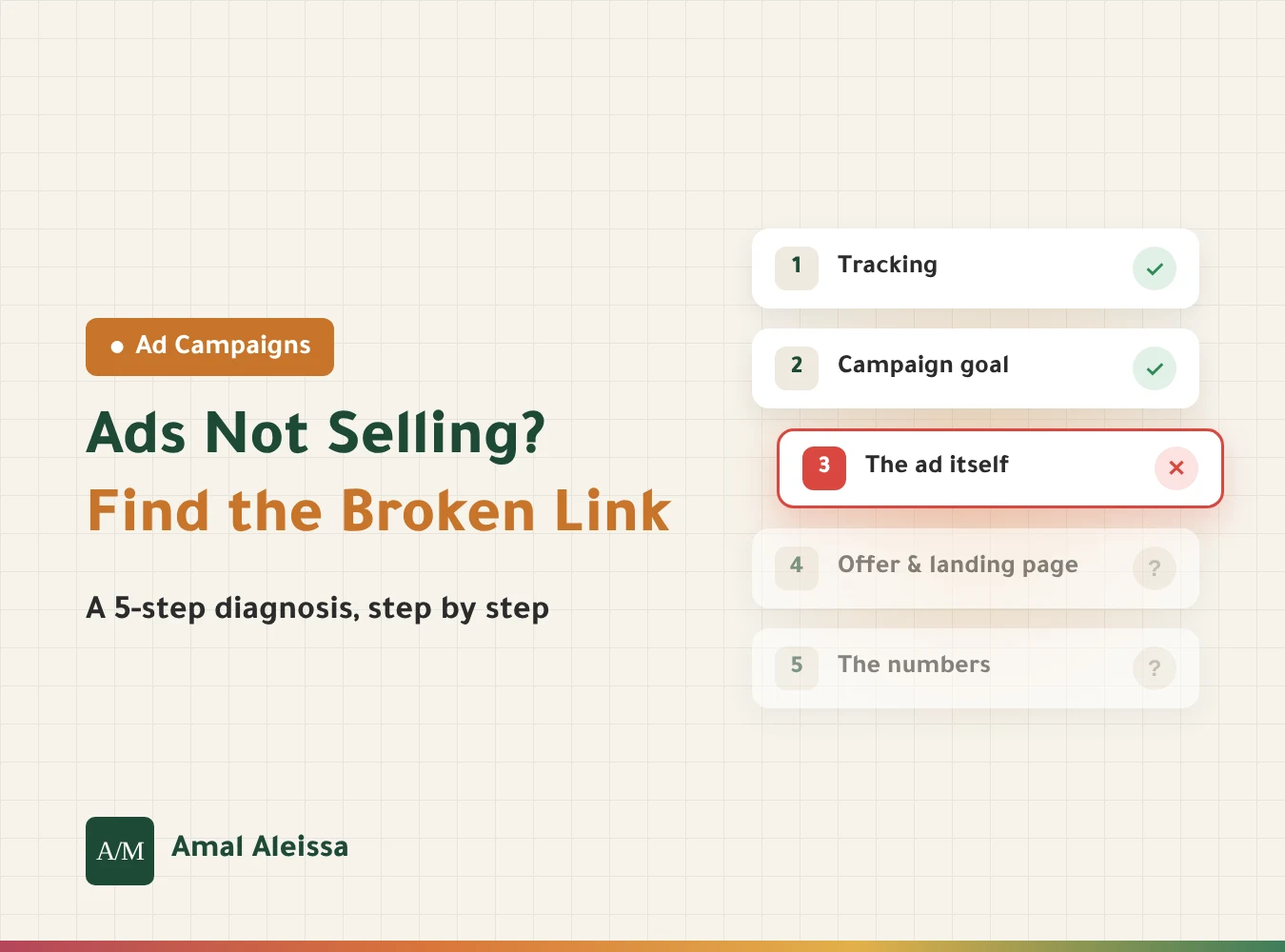
I see an ad campaign as a chain of five connected links. If one link breaks, every link after it fails, no matter how strong it is. So don't change everything at once. Check the links in order, and stop at the first broken one.
Link 1: Can the ad platform actually see your sales?
Most advertisers ignore this link, yet in my experience it's the first thing I check in any ad account.
Platforms like Meta, TikTok, Snapchat and Google Ads learn from tracking data: the pixel, the Conversions API, and events sent through Google Tag Manager. If a purchase isn't recorded, is recorded twice, or arrives without the order value, the algorithm is optimizing your campaign blindfolded.
Check it yourself: compare the number of orders in your store (Salla, Zid or Shopify) over one week with the number of purchases the ad platform reports for the same week. A big gap between the two means the problem starts here, and any other optimization before fixing it is wasted effort.
Link 2: Did you ask the platform for the right thing?
The algorithm does exactly what you ask. If you choose a traffic objective when you want sales, the platform will bring you people who like to click, not people who buy.
Two common mistakes also live in this link:
- Constant editing: every major change to budget, audience or creative sends the campaign back into the Learning Phase, so it never stabilizes.
- Splitting the budget across too many ad sets: none of them collects enough data to learn.
Check it yourself: review the optimization goal of every campaign, and count how many edits you made in the last seven days.
Link 3: Does your ad stop the scroll?
A few years ago, success depended on picking interests and age groups precisely. Today that has changed: platforms prefer broad targeting, and the ad itself decides who engages with it. In other words, the creative has become the targeting.
So if your ad is generic, looks like your competitors' ads, or says nothing in its first seconds, no setting will save it.
Also watch for creative fatigue: an ad that performed brilliantly a month ago may decline because the audience has seen it too many times.
Check it yourself: don't just test colors and fonts. Test different message angles: one that addresses a problem the customer lives with, one that highlights the result they'll get, and one built on real customer experiences.
Link 4: Is the offer worth buying?
Sometimes the ad is excellent, the clicks are plentiful, and the problem isn't the ad at all.
The customer arrived, then found:
- A higher price than expected, or a shipping fee that suddenly appears at checkout
- A slow page on mobile
- No reviews and no clear return policy to give them confidence
- A link that takes them to the homepage instead of the product page they liked in the ad
The ad brings interest, but the offer and the page are what turn interest into a purchase.
Check it yourself: open your ad on your phone, tap it, and go through the order all the way to the checkout page. Every moment of hesitation you felt, your customer felt too.
Link 5: Are you judging the campaign by the right numbers?
Many campaigns are stopped while they're working, and many keep running while they're losing money, because the judgment is based on secondary metrics like likes or views.
The metrics that matter for a sales campaign are:
- Cost per acquisition (CPA): how much you pay for each purchase
- Return on ad spend (ROAS): how much revenue comes back for every riyal you spend
- Conversion rate: how many visitors out of 100 complete a purchase
Most importantly, know your break-even point. The formula is simple: divide 1 by your profit margin. If your margin is 40%, you need a ROAS of at least 2.5 to avoid losing money. Anything lower means you're selling and losing at the same time.
Quick diagnosis table
What you notice in your account → the link most likely at fault:
- Orders in your store that don't show up in the ad platform → Link 1: tracking
- Lots of clicks and almost no sales → Link 2: campaign goal, or Link 4: offer and page
- Lots of impressions and few clicks → Link 3: the ad itself
- Great performance followed by a sudden drop → Link 3: creative fatigue, or Link 2: edits that reset the learning phase
- Sales coming in but no profit → Link 5: ROAS below break-even
Frequently asked questions about paid ads
How many days should I wait before judging a campaign?
It's about the amount of data, not the number of days. Meta, for example, recommends around 50 conversions per week per ad set to exit the learning phase. Judging before that is usually premature.
Should I raise the budget if results are weak?
No. Raising the budget amplifies what's already there: if the campaign is losing, you'll lose more. Only scale once the campaign has proven it's above break-even.
Is broad targeting always better?
In most cases on Meta and TikTok, yes, as long as tracking is accurate and the creative is strong. Without both, the platform won't know who to look for.
Are paid ads right for every business?
Not at every stage. If you don't have accurate tracking, a ready landing page, and a profit margin that can absorb the acquisition cost, it's better to set up those basics before spending a single riyal.
The takeaway
A campaign that doesn't sell rarely has one big mistake. More often, it's one broken link that disrupts everything after it.
Start with tracking, then setup, then the ad, then the offer, then the numbers. And fix one link at a time so you know what actually made the difference.
If you'd like us to review your ad account together and find the broken link, book an ad campaigns consultation here: https://www.amalaleissa.com/en#contact